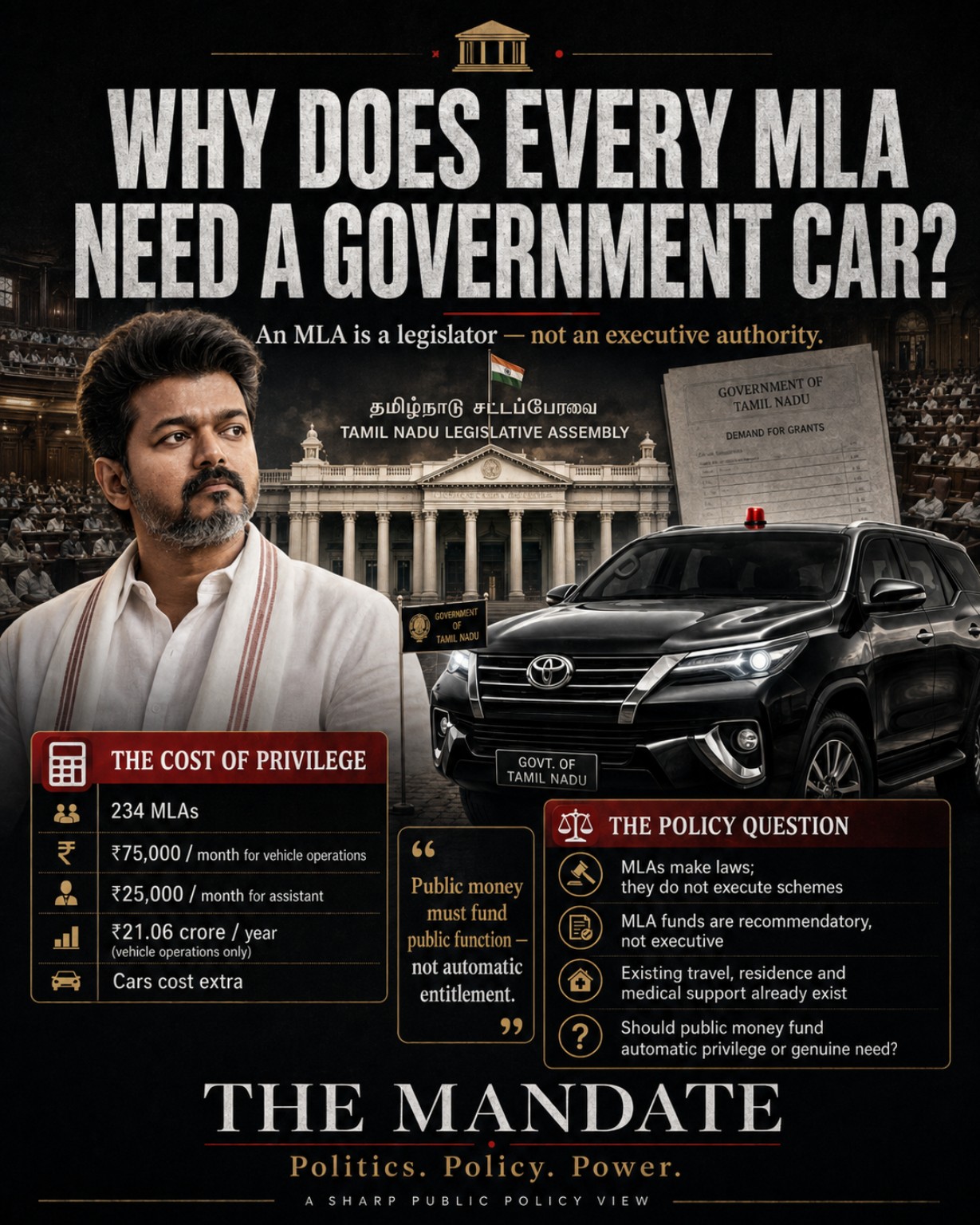
Tamil Nadu has announced a government vehicle for all 234 MLAs, along with ₹75,000 per month for driver, fuel, and maintenance, and an additional ₹25,000 for an assistant.
The assistant provision is not the issue.
An MLA handles petitions, legislative research, constituency representation, and continuous coordination with government departments. Professional staff can significantly enhance the quality and efficiency of representation.
However, the provision of a government car raises a more fundamental question.
An MLA, by virtue of office alone, is not an executive authority.
The Legislature is responsible for making laws, scrutinising the government, and authorising public expenditure. Under Articles 203–204 of the Constitution, the Assembly votes on demands for grants and authorises appropriation from the State Consolidated Fund. Executive power, in contrast, is exercised through the constitutional executive and administrative machinery.
Even the MLA Constituency Development Scheme itself reflects this distinction.
Tamil Nadu Government guidelines clearly state that the MLA identifies and proposes works, while the District Collector provides administrative sanction and designates the implementing agency. The MLA recommends; the executive executes.
So the question arises: why are legislators being equipped as though they are executive field officers?
MLAs already receive substantial mobility and institutional support under existing provisions, including:
- ₹25,000 per month vehicle allowance for MLAs
- ₹5,000 attendant allowance
- Free travel across Tamil Nadu on State Transport Corporation buses, including AC sleeper services under statutory provisions
- ₹20,000 annual railway travel allowance
- Government-allotted accommodation at a nominal rent of ₹250 per month, subject to rules
- Free treatment in State Government hospitals, and financial assistance for major medical procedures in private hospitals in India, subject to eligibility conditions
Now, in addition, a government car is being provided along with ₹75,000 per month per MLA.
This alone amounts to:
₹75,000 × 234 × 12 = ₹21.06 CRORE PER YEAR — before the cost of procuring vehicles is even considered.
The Government must also address a critical question:
Will the existing ₹25,000 monthly vehicle allowance be withdrawn once a government car is provided?
If not, what is the rationale for funding the same mobility requirement twice?
A comparison with Parliament is also instructive.
Members of Parliament represent larger constituencies and broader geographies. Parliament’s official framework provides extensive travel, accommodation, and medical facilities. However, it does not establish a universal entitlement of a government-purchased vehicle for every MP.
If constituency travel alone justifies a taxpayer-funded vehicle, where does that principle end?
An MP covers a significantly larger area.
Should the next step be government SUVs for MPs? And beyond that, aircraft, given the scale of parliamentary constituencies?
Public finance must be guided by a clear limiting principle.
There is also a structural issue: all 234 constituencies do not have identical transport requirements.
A compact urban constituency in Chennai and a large, dispersed rural constituency cannot reasonably be treated as having the same mobility needs.
Nor are all MLAs in identical economic circumstances.
Publicly available election affidavit data highlights this variation. Leema Rose Martin has declared assets of approximately ₹1,049.5 crore; ADR’s analysis records R.S. Murugan at about ₹158.5 crore, Udhayanidhi Stalin at around ₹33.9 crore, and E.V. Velu at approximately ₹20.8 crore.
This is not a comment on any individual.
It simply underscores why a blanket approach based on “ALL MLAs” is difficult to justify.
Whether it is Leema Rose Martin, Udhayanidhi Stalin, E.V. Velu, R.S. Murugan, Dr. T. Arunkumar, or any other legislator, the State has not demonstrated that every MLA has an identical transport requirement.
A more rational approach would be to provide government vehicles selectively — based on objective criteria such as constituency geography, verified mobility needs, disability, security considerations, or lack of access to reliable transport — while using pooled vehicles, leasing models, or audited reimbursement systems elsewhere.
Entitlements should be based on FUNCTION, not merely POSITION.
Mayors, local body executives, and government officers have direct administrative and implementation responsibilities. An MLA’s role is constitutionally significant, but fundamentally different in nature.
Provide MLAs with well-equipped offices.
Provide professional staff.
Provide research and data support.
Provide digital grievance redress systems.
Provide targeted mobility assistance where genuinely required.
But why provide a government car to every MLA solely on the basis of election to office?
This is not about whether Tamil Nadu can afford ₹21 crore or more.
It is about a larger principle:
PUBLIC MONEY MUST FUND PUBLIC FUNCTION — NOT AUTOMATIC ENTITLEMENT.
Strengthen the Legislature. Support the MLA’s office. Fund genuine need. But do not convert elected office into an ever-expanding bundle of automatic privileges.