


NOT MANDATE | EDITORIAL
On Friday, August 21, 2026, a discussion on electricity should have examined tariffs, agricultural connections, tender irregularities, power-sector debt and the alleged disappearance of hard disks from TANGEDCO offices.
Instead, Tamil Nadu watched the debate descend into a personal exchange.
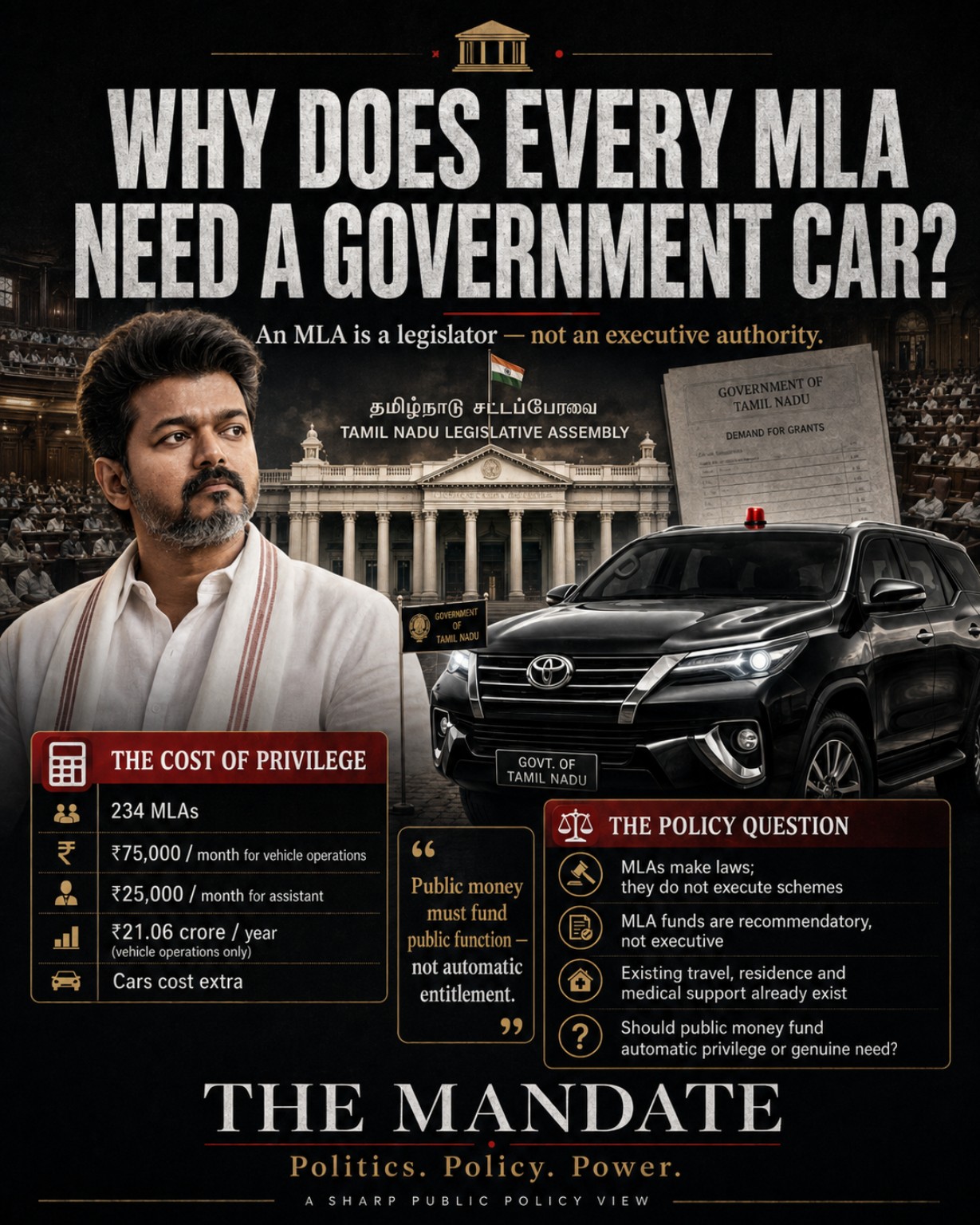
Leader of the Opposition Udhayanidhi Stalin referred to Electricity Minister Nirmal Kumar as a “Sanghi Minister.” The Minister retaliated by describing him as a “three-hour bathroom Opposition Leader.” Elsewhere in the same sitting, Minister Aadhav Arjuna responded to criticism over government cars for MLAs by referring to Udhayanidhi Stalin’s private houses and his use of an official bungalow.
One can endlessly debate who provoked whom and whose insult was harsher.
But that is a party argument.
The democratic question is more serious:
When did the Tamil Nadu Legislative Assembly move from questioning policies to questioning bathrooms, houses and personal habits?
Ministers carry a greater responsibility
The Opposition is not exempt from standards. Calling a minister a political label instead of challenging his figures is not an adequate legislative response. The Leader of the Opposition must demonstrate restraint because he represents a constitutional institution, not merely a political party.
However, ministers carry an even greater responsibility.
A minister does not rise merely as a party spokesperson. He rises with the authority of the Government of Tamil Nadu, supported by departmental files, public officials, data and public money.
When questioned, a minister must answer with:
Facts. Figures. Files. Decisions. Deadlines.
Not personal insinuations.
Not cinematic counters.
Not electoral victory speeches.
Not remarks designed to become the evening’s most viral reel.
The interventions of Ministers Nirmal Kumar, Aadhav Arjuna and Ramesh, among others, increasingly suggest that some members of the government are treating every question as an opportunity for political retaliation. Minister Ramesh had earlier turned a discussion on Assembly decorum into a dispute over whether the Opposition Leader should stand when the Chief Minister entered the House. The Speaker eventually clarified that this was a matter of convention and individual choice, not an enforceable requirement.
These interventions may excite party supporters. But they do not improve administration.
A sharp reply can win applause for thirty seconds. A precise reply can improve governance for five years.
Live telecast is not the problem
The full telecast of Assembly proceedings is an important democratic reform. It allows citizens to assess the attendance, preparedness, knowledge and conduct of their representatives directly.
Women, students, first-time voters, young political aspirants and entire families are now watching the House—not merely short excerpts selected by television channels.
That must make legislators more responsible, not more theatrical.
The solution is not to switch off the cameras.
The cameras must remain on. The standards must rise.
The difficulty is that the Assembly’s traditional practice of expunging inappropriate remarks no longer works effectively in the digital age.
By the time the Speaker orders a sentence removed from the official record, it has already been broadcast, screen-recorded, clipped, captioned and circulated through YouTube, Instagram, X and WhatsApp. The Speaker has warned that action may be taken against those publishing reels made from expunged portions.
But threatening the person who shares the clip addresses only the final stage of the problem.
The first responsibility lies with the legislator who made the remark.
Expunction is an eraser in a screenshot age
The Opposition Leader has claimed that, in the present session, the Speaker has expunged more remarks made by ruling-party members than those made by Opposition members. He also pointed out that these deleted remarks continue to circulate online because the proceedings were originally broadcast live.
The Speaker deserves credit for removing objectionable words from the ruling side as well. The Chair must protect the dignity of the House irrespective of party strength.
But deletion after the event is no longer enough.
Under Rule 119 of the Tamil Nadu Legislative Assembly Rules, the Speaker may expunge words considered defamatory, indecent, unparliamentary, undignified or incriminatory. Rules 120 and 121 also provide powers to order the withdrawal of a disorderly member or initiate suspension proceedings against a member who repeatedly disregards the Chair.
The Speaker therefore has more than an eraser.
He has disciplinary authority.
That authority must be used immediately and impartially. A personal remark should require an instant withdrawal and apology. A repeated violation should lead to the microphone being stopped and speaking time being withdrawn. Persistent violations should invite naming, withdrawal or suspension under the Rules.
Otherwise, expunction may unintentionally become part of the performance: make the sensational remark, obtain the viral clip, allow the Speaker to delete it later—and still collect the political benefit.
Even the Chair must avoid the reel culture
Humour has always had a place in legislative debate. It can reduce tension and make serious exchanges more humane.
But the Speaker must remain careful not to become another participant in the competition for viral punchlines. A recent counter from the Chair was widely celebrated online as a “thug-life” moment. It may have generated laughter, but the presiding officer’s primary public currency must remain neutrality, restraint and authority—not virality.
The Chair cannot warn ministers and members against reel-driven politics while being drawn into the same ecosystem.
Tamil Nadu needs a live-broadcast code of conduct
All parties should agree on a specific code for live proceedings.
Personal references involving homes, families, physical appearance, private habits, health, caste insinuations or unverified criminal allegations must trigger an immediate withdrawal. Official party accounts and members’ social-media teams must be prohibited from circulating portions subsequently expunged by the Chair.
The Assembly Secretariat should publish a daily disciplinary note identifying the member, the applicable rule and the action taken—without reproducing the offensive words.
A brief technical delay in the public broadcast may also be examined, while preserving the complete original recording securely for archival and legal purposes. The Madras High Court had earlier suggested a deferred telecast as one possible way of handling remarks that may subsequently be expunged.
Most importantly, every minister must be instructed to answer departmental questions with departmental information. The Assembly is not an extension of an election platform.
The House is a democratic classroom
Young people watching the Assembly should learn that an Opposition can challenge a government fearlessly without becoming personally abusive.
They should learn that a minister can answer criticism confidently without humiliating an opponent.
They should learn that a Speaker protects every member equally and prevents the numerical strength of the ruling party from becoming verbal dominance.
Instead, they are increasingly being taught that the quickest personal counter wins the debate.
That is not legislative democracy.
That is political entertainment performed inside a constitutional institution.
An MLA is not a troll.
A minister is not a rebuttal influencer.
An Opposition Leader is not a meme target.
And the Assembly is not a content studio.
Tamil Nadu fought for the democratisation of education, representation, language and political participation. Its Assembly cannot now normalise a political culture in which policy is secondary and personal humiliation becomes the headline.
Keep the telecast live.
Keep the Opposition aggressive.
Keep ministers accountable.
But keep the language within the constitutional dignity of the House.
Because words deleted from the Assembly record may disappear from paper.
They remain permanently recorded in the minds of the next generation.
Sources / References
- Indian Express Tamil — Assembly exchange
- Indian Express Tamil — Assembly debate
- Indian Express Tamil — expunged remarks and reels
- Indian Express Tamil — Assembly decorum exchange
- DT Next — Speaker warning on expunged clips
- Dinamalar — expunged remarks and online circulation
- Indian Kanoon — Assembly rules context
- Indian Express Tamil — Speaker viral exchange
- The New Indian Express — live telecast and expunction